


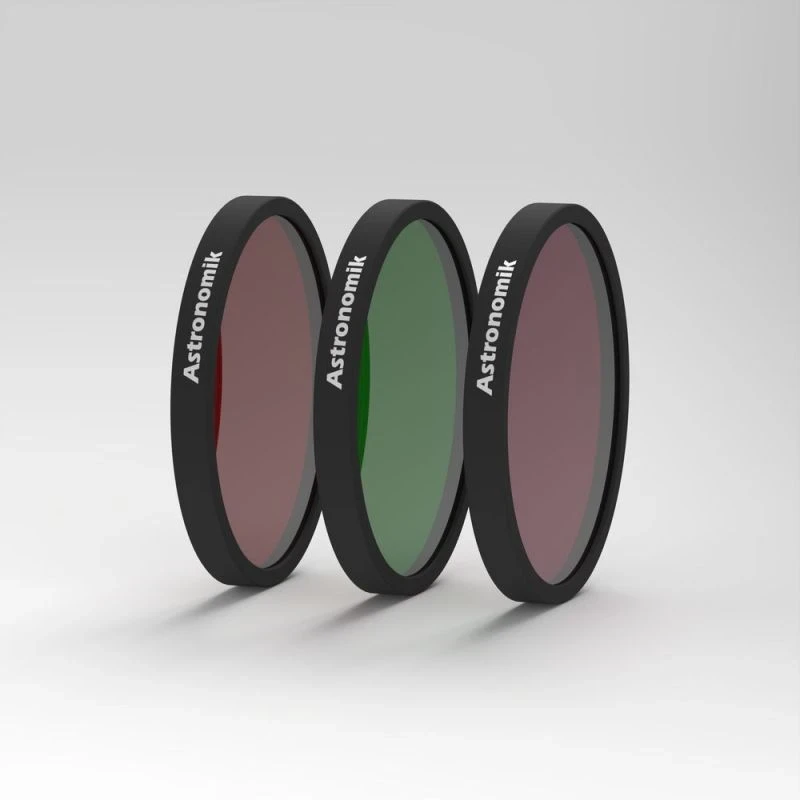
The Astronomik narrowband filters are an excellent choice for any astrophotographer who wants to capture the most contrast-rich and detailed deep-sky images possible. These filters significantly reduce the effects of light pollution, allowing for spectacular images even in bright urban skies. Astronomik photographic filters can be used not only with traditional CCD cameras but also with digital SLR cameras and even video and webcams.
The filters have excellent light transmission properties in the selected wavelength range, while completely "cutting off" light at other "undesired" wavelengths. As a result, the contrast between the celestial background and the observed object increases, allowing faint details to be captured. Unlike visual filters, they "cut off" the IR range.
Halo-free imaging and premium solutions
It is quite common that when a narrowband filter is placed in the light path, a disturbing halo appears around brighter stars. This undesirable phenomenon is true for filters from almost all manufacturers and naturally reduces the aesthetic value of our images. Fortunately, Astronomik's experts have managed to eliminate this optical flaw. Through meticulous adjustments to the coatings, they have ensured that photos taken with Astronomik filters are halo-free!
It is also noteworthy that Astronomik photographic filters are parfocal with each other, meaning there is no need to refocus the camera every time a filter is changed.
All Astronomik deep-sky filters are manufactured with maximum care and precision, ensuring the best possible contrast and light transmission. The extremely precisely polished glass material and the approximately 130-layer vapor-deposited filter coating clearly elevate Astronomik filters above their competitors. Another advantageous feature is their exceptional scratch resistance, so they retain their transmission characteristics even after many years of intensive use. Thanks to the premium quality materials and craftsmanship, Astronomik filters do not degrade image quality in the slightest. Unlike cheaper filters, stars remain completely point-like.